Noise-Adaptive Diffusion Sampling for Inverse Problems Without Task-Specific Tuning

Yingzhi Xia1*, Setthakorn Tanomkiattikun1,3*, Liangli Zhen1✉, Zaiwang Gu2
1Institute of High Performance Computing, Agency for Science, Technology and Research, Singapore   2Institute for Infocomm Research, Agency for Science, Technology and Research, Singapore   3Johns Hopkins University
* Equal contribution.   |   ✉ Corresponding author.
Xia_Yingzhi@a-star.edu.sg   |   zhen_liangli@a-star.edu.sg   |   Gu_Zaiwang@a-star.edu.sg   |   stanomk1@jhu.edu

Motivation and Method
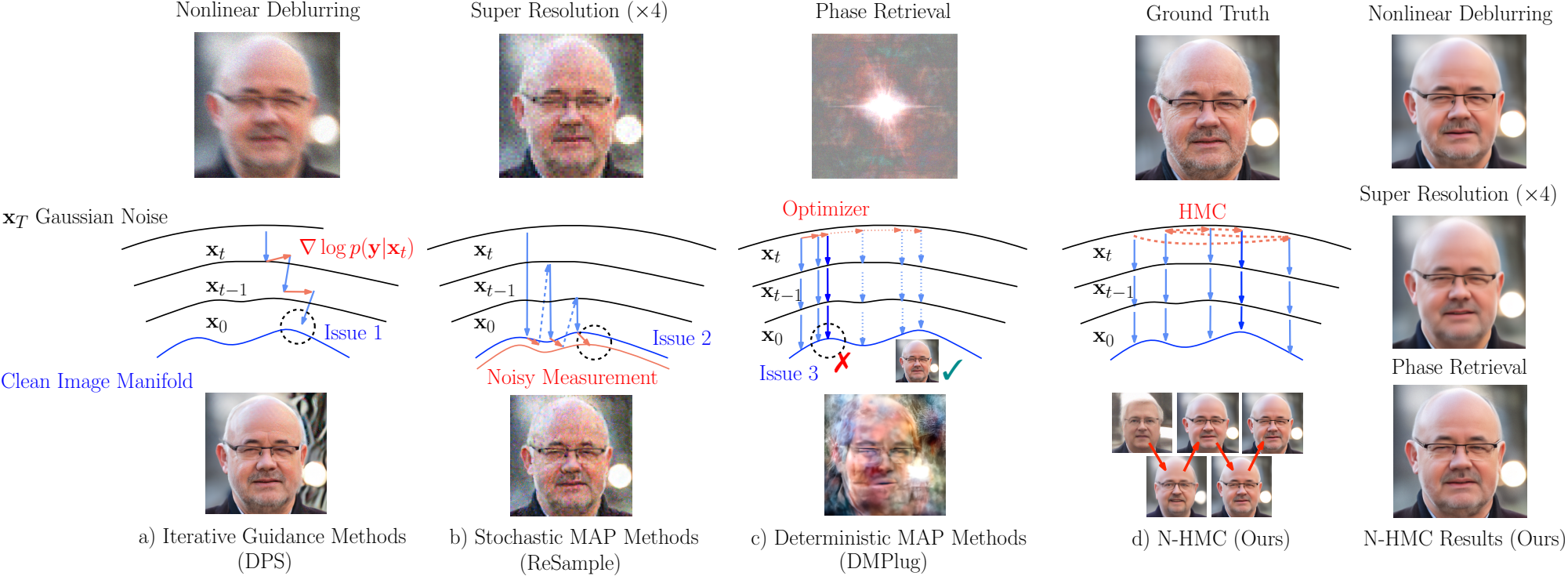
Comparison of existing methods and NA-NHMC

Figure. Comparison of existing methods and their limitations with the N-HMC method. (a) Iterative Guidance Methods (DPS) lead to manifold infeasibility. (b) Stochastic MAP methods (ReSample) are susceptible to overfitting to noise. (c) Deterministic MAP methods (DMPlug) become trapped in a local mode. (d) Our method performs sampling in the noise space xT and maps samples to images via a deterministic mapping x0 = D(xT).

Abstract

Diffusion models have shown strong performance in inverse problems, but existing approaches often suffer from manifold infeasibility, noise overfitting, or local-mode collapse. We propose Noise-space Hamiltonian Monte Carlo (N-HMC), which treats reverse diffusion as a deterministic mapping from initial Gaussian noise to clean images and performs posterior sampling entirely in the noise space. This formulation keeps proposals on the learned manifold and enables robust posterior exploration. We further introduce Noise-Adaptive N-HMC (NA-NHMC), which marginalizes unknown measurement noise variance and removes task-specific tuning of noise-level hyperparameters. Across linear and nonlinear inverse problems on FFHQ and ImageNet, NA-NHMC delivers strong reconstruction quality and robust behavior under unknown noise.

Sampling Dynamics Across Inverse Problems

Three representative inverse problems. Each task card shows reference image, measurement, and NA-NHMC convergence trajectory.

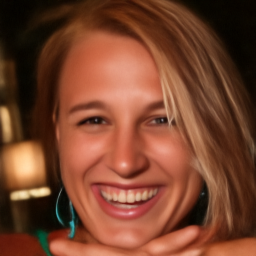
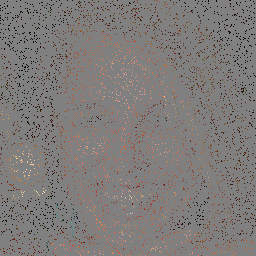
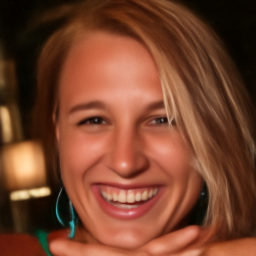
Phase Retrieval

Setting: FFHQ 256x256, observation noise sigma_y=0.01. Detail: Fourier-magnitude measurements cause severe ambiguity; trajectory shows gradual manifold-aligned recovery.

Reference
Reference for phase retrieval
Measurement
Measurement for phase retrieval
NA-NHMC Convergence Trajectory
NA-NHMC trajectory for phase retrieval

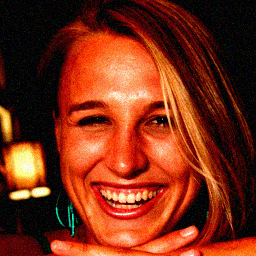
Random Inpainting (92%)

Setting: FFHQ 256x256, random mask ratio 92%, observation noise sigma_y=0.05. Detail: Most pixels are missing; NA-NHMC samples progressively restore global structure and local facial textures.

Reference
Reference for inpainting
Measurement
Measurement for inpainting
NA-NHMC Convergence Trajectory
NA-NHMC trajectory for inpainting

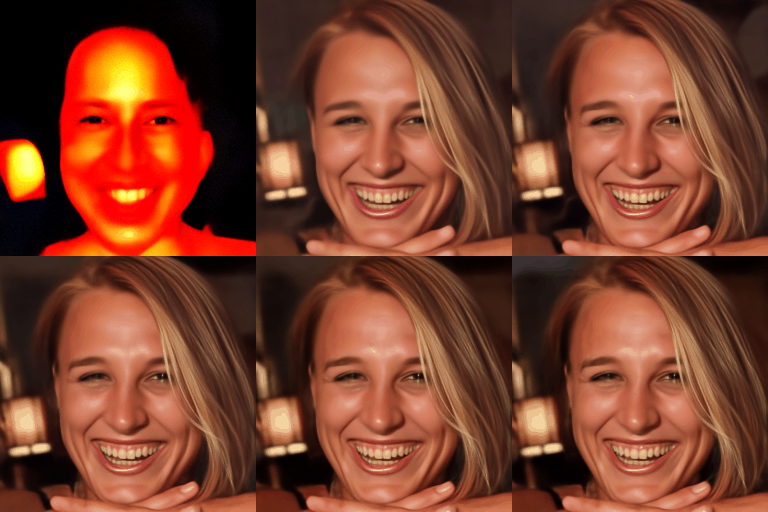
HDR Reconstruction

Setting: FFHQ 256x256, nonlinear camera response, observation noise sigma_y=0.05. Detail: Trajectory illustrates iterative correction of exposure and contrast while preserving semantic consistency.

Reference
Reference for HDR
Measurement
Measurement for HDR
NA-NHMC Convergence Trajectory
NA-NHMC trajectory for HDR

Experimental Results

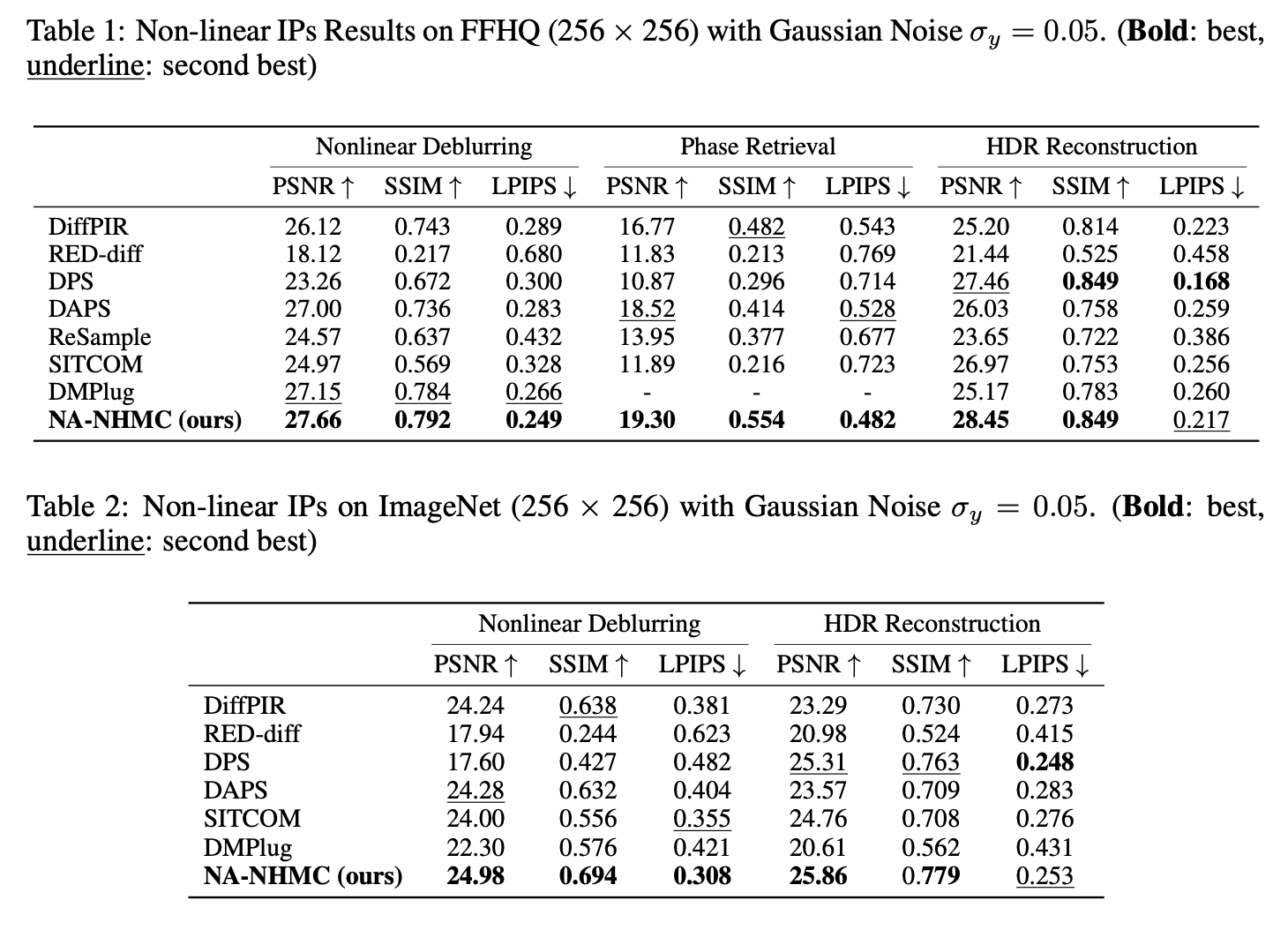
Main Quantitative Comparison

Key benchmark table from the paper. It summarizes performance over representative linear and nonlinear inverse problems. NA-NHMC consistently improves robustness, especially in difficult nonlinear settings and unknown-noise scenarios.

Main quantitative table from paper
Main result table highlighting competitive or best performance of NA-NHMC across tasks and metrics.

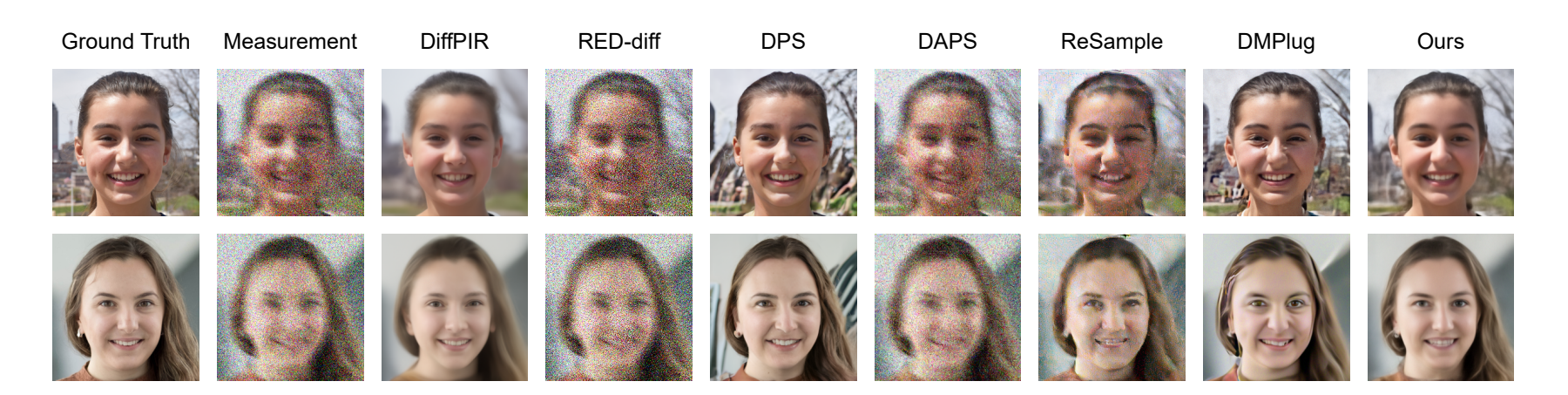
Nonlinear Deblurring Visual Comparison

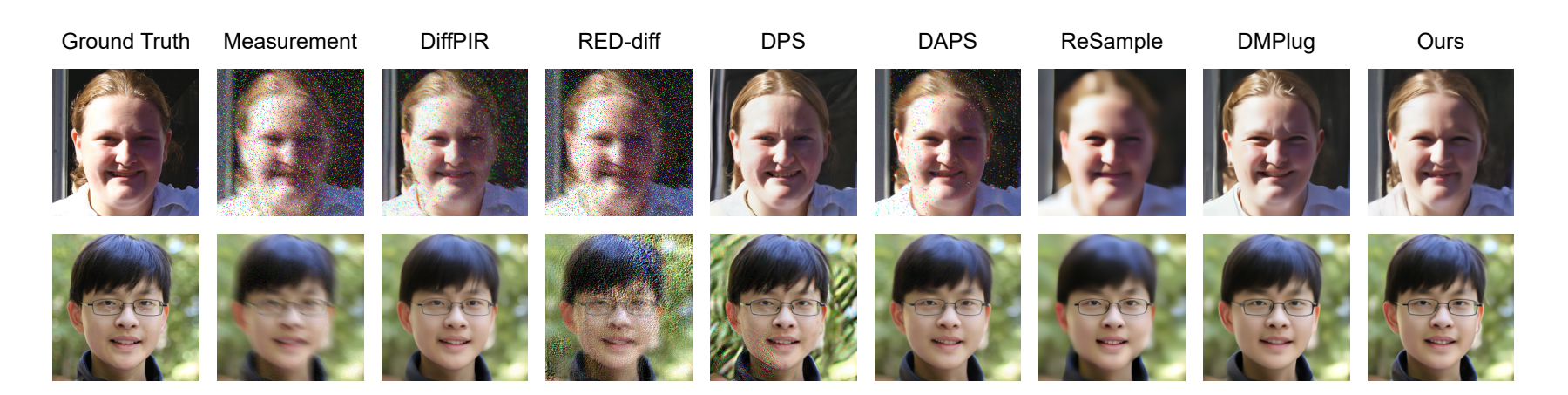
Under high noise (σy=0.2), NA-NHMC recovers sharper facial details with fewer artifacts than prior baselines.

Nonlinear deblurring qualitative results
Nonlinear deblurring results on FFHQ (256×256) with σy=0.2.

Unknown Noise Robustness

With the same hyperparameter setting used for Gaussian experiments, NA-NHMC remains strong under impulse and speckle noise.

Unknown noise qualitative results
Nonlinear deblurring on FFHQ under impulse noise (top) and speckle noise (bottom).

Initialization Robustness

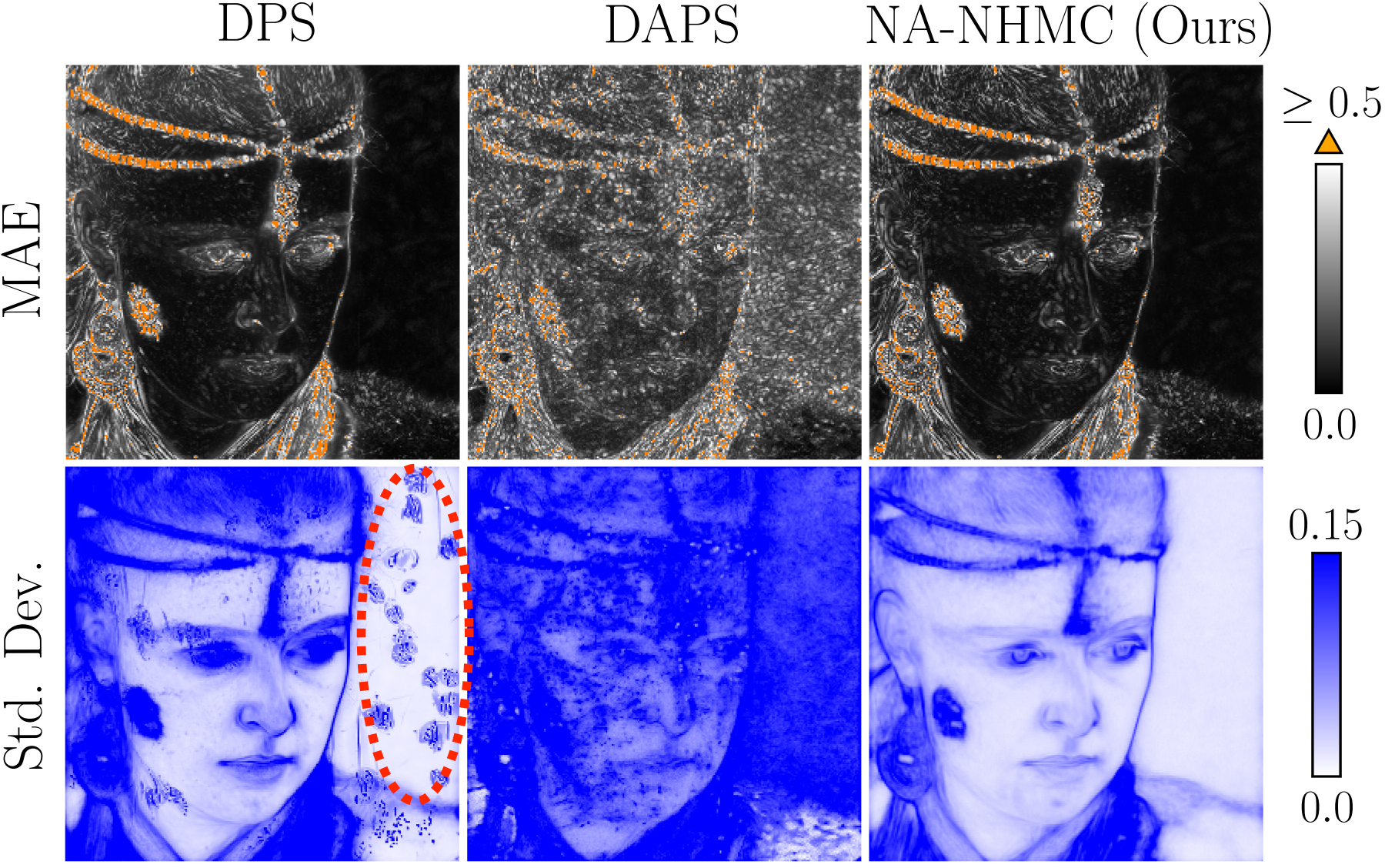
Compared with DPS and DAPS, NA-NHMC shows lower variance across repeated runs while preserving reconstruction fidelity.

Heatmap robustness visualization
Top: MAE heatmaps. Bottom: standard deviation heatmaps over 100 runs.

Convergence in Highly Ill-Posed Task

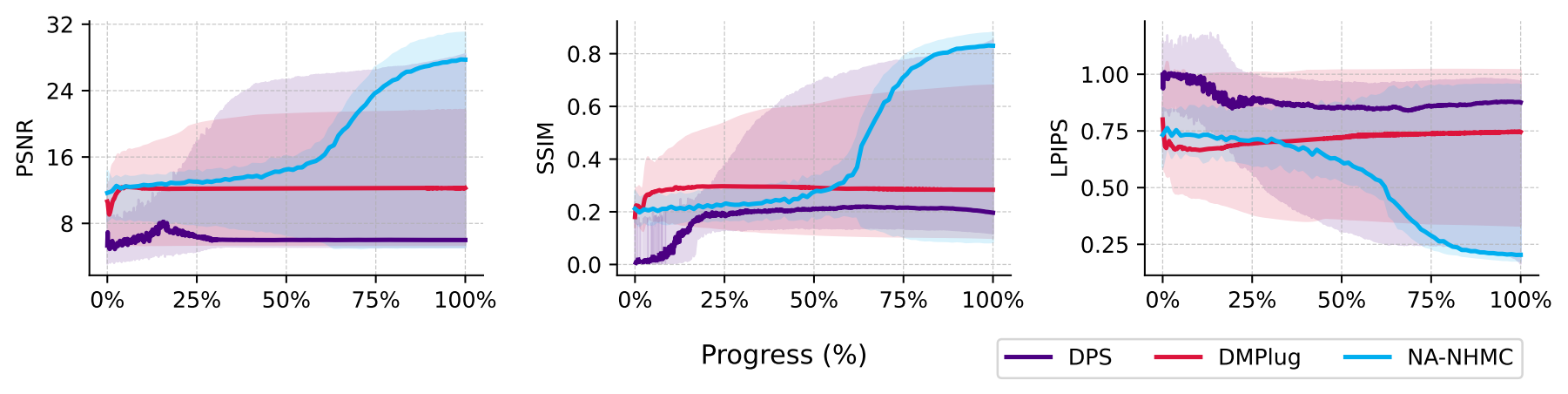
The annealed noise schedule improves early exploration and raises successful recovery rate in phase retrieval.

Phase retrieval convergence
Phase retrieval on FFHQ (256×256), σy=0.01; median with 5th–95th percentile band.

BibTeX

@inproceedings{
tanomkiattikun2026noiseadaptive,
title={Noise-Adaptive Diffusion Sampling for Inverse Problems Without Task-Specific Tuning},
author={Yingzhi Xia and Setthakorn Tanomkiattikun  and Liangli Zhen and Zaiwang Gu},
booktitle={The Fourteenth International Conference on Learning Representations},
year={2026},
url={https://openreview.net/forum?id=Yfk4ex3Z1G}
}